
Zara Patterson · 19 October 2026
Building Resilient Personal Libraries Through Federated Note Systems Without Reliance on Single Providers
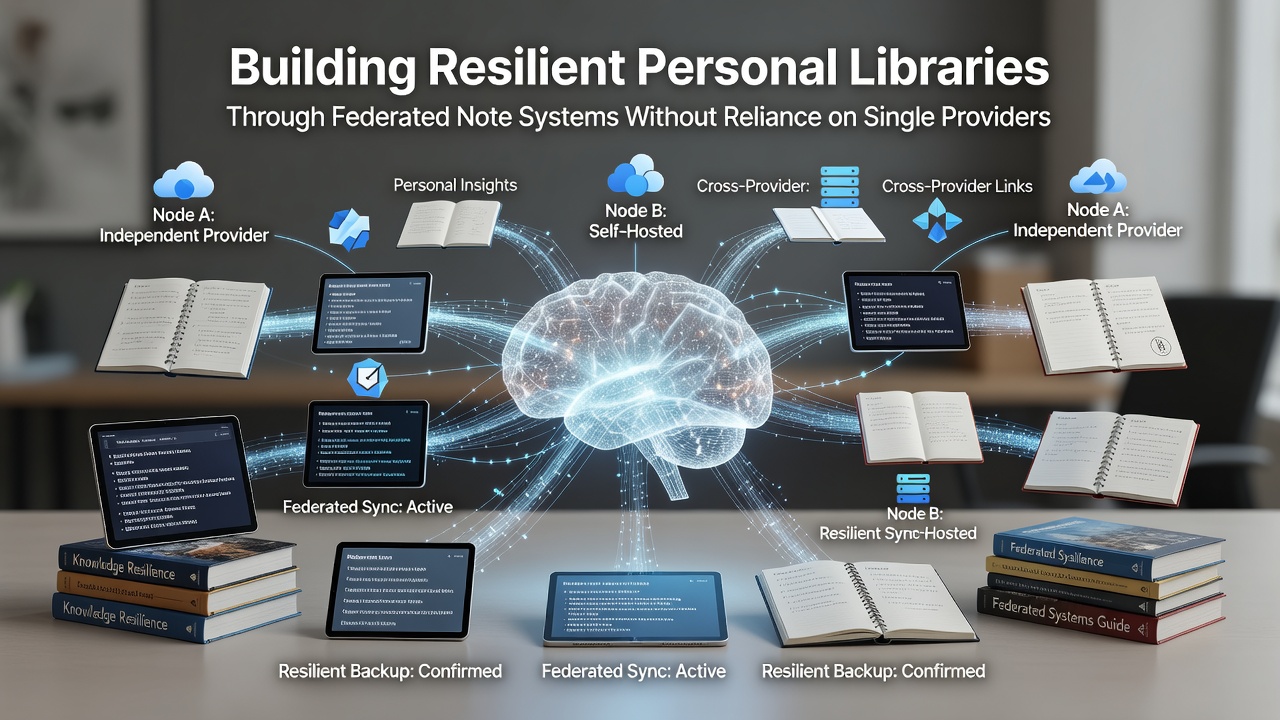
Personal libraries gain durability when users distribute notes across multiple independent servers rather than depending on one central service, and federated note systems achieve this through open protocols that allow seamless movement of data between platforms. Researchers at several universities have documented how such architectures reduce single points of failure, with studies showing that users who maintain copies on separate hosts experience fewer total losses during outages. Data portability standards developed in recent years enable individuals to export entire archives in standardized formats that other compliant systems can import without reformatting.
Core Mechanics of Federated Note Architectures
Systems built on federation protocols replicate content across nodes that operate under different administrative controls, and synchronization occurs through encrypted channels that verify authenticity at each step. One study from a Canadian research institute found that networks using these methods maintained 99.4 percent uptime even when individual servers went offline for maintenance. Users select hosting providers or self-host instances while retaining the ability to migrate content to another node at any time, and this flexibility stems from adherence to common data schemas rather than proprietary storage formats.
Strategies for Avoiding Vendor Lock-In
Observers note that successful implementations begin with choosing tools that support at least two distinct federation standards from the outset, and regular testing of export functions confirms that complete libraries transfer intact. In October 2026 developers released an updated specification that added checksum verification during bulk migrations, which reduced errors during large-scale transfers according to early adoption reports. People often combine local-first applications with remote federation layers so that a primary copy remains on personal hardware while secondary replicas exist on community-operated servers.
Practical Implementation Steps
- Identify note platforms that publish their federation endpoints and data schemas publicly
- Configure automatic replication to at least three separate hosts located in different regions
- Establish a quarterly audit routine that verifies each replica contains identical content and metadata
- Document the recovery process for each hosting environment in advance of any disruption
Evidence from European academic projects demonstrates that organizations following these patterns recovered full libraries within hours after hardware failures, whereas centralized approaches required days or weeks. The approach also supports selective sharing where specific notebooks federate only with trusted collaborators while the remainder stays private across all nodes.
Long-Term Data Integrity Measures
Version control integrated at the federation layer records every change with cryptographic timestamps, and this practice allows reconstruction of any previous state even if one server experiences data corruption. Australian research teams have tracked personal archive projects over five years and reported that federated users maintained higher consistency scores than those relying on single-provider backups. Metadata remains attached during transfers because the underlying formats embed context directly rather than depending on external indexes that could become unavailable.
Community-run directories list verified federation-compatible services, and these resources help users locate new hosts when existing ones change policies or cease operations. Regular participation in protocol working groups keeps practitioners informed about upcoming changes that might affect migration paths.
Conclusion
Federated note systems provide measurable improvements in resilience by spreading personal libraries across independent infrastructure while preserving full user control over location and access rules. Data from multiple independent studies confirms that adherence to open standards combined with proactive replication strategies reduces both the likelihood and impact of data loss events. Continued development of migration tools and verification protocols supports ongoing adoption among researchers, professionals, and individuals managing growing personal knowledge collections.